
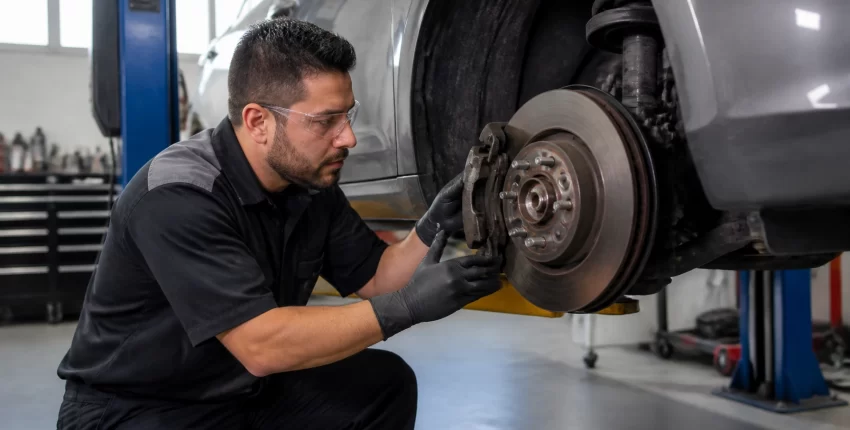

Most drivers expect brake trouble to announce itself with a loud squeal. Sometimes it does: but noise is only one way your vehicle communicates that its braking system needs attention.
Changes in pedal feel, steering response, stopping distance, dashboard lights, or the appearance of your brake components can all provide an earlier warning. Recognizing these signs gives you a better chance of addressing a minor issue before it damages rotors, calipers, brake lines, or other safety-critical parts.
If you drive in Lower Sackville or the surrounding Nova Scotia area, regular brake awareness is especially important. Moisture, road salt, temperature changes, hills, and stop-and-go traffic can all affect how your braking system performs over time.
Here are the warning signs to watch for: beyond the squeal.
1. Your Brake Pedal Feels Soft, Spongy, or Low
A healthy brake pedal should feel firm and consistent. When you press it, the vehicle should begin slowing predictably without requiring excessive effort.
A pedal that feels soft, spongy, or unusually low may indicate a problem with the hydraulic side of the braking system. Possible causes include air or moisture in the brake lines, low brake fluid, a leak, worn components, or a master cylinder problem.
Pay attention if:
- The pedal travels farther toward the floor than it used to.
- You need to press harder to achieve the same braking response.
- The pedal feels springy or mushy under your foot.
- You need to pump the pedal before it feels firm.
- The pedal continues sinking while you hold pressure at a stop.
A pedal that goes nearly or completely to the floor is an urgent safety concern. Do not continue driving normally and hope it improves. Your vehicle should be inspected as soon as possible.
2. The Steering Wheel or Brake Pedal Vibrates
A vibration that appears specifically when you brake is another important warning sign. You may feel it through the steering wheel, brake pedal, or the body of the vehicle.
Brake pulsation can be associated with uneven rotor surfaces or variations in rotor thickness. It may become more noticeable when slowing from highway speeds, although even a mild vibration during ordinary stops deserves attention.
You might notice:
- A pulsing sensation under your foot.
- The steering wheel shaking during braking.
- A repeated “up and down” feeling from the pedal.
- The vehicle shuddering as you slow down.
A vibration does not automatically mean the rotors are “warped.” Brake components, wheel hardware, tires, and suspension parts can sometimes create similar symptoms. That is why a proper inspection matters. A technician can measure the relevant components instead of replacing parts based on a guess.
AAA also identifies shaking or impaired stopping as symptoms that should be checked promptly. You can review its general brake guidance in 4 Signs That Your Brakes Need Service.
3. Your Vehicle Pulls When You Apply the Brakes
Does your car drift or pull to the left or right when you slow down? If it drives straight most of the time but changes direction under braking, the brake system may not be applying equal force at each wheel.
Common causes can include:
- Uneven brake pad wear.
- A sticking or seized caliper.
- A restricted brake hose.
- Contamination on a pad or rotor.
- Uneven friction between the wheels.
Pulling is more than an inconvenience. During an emergency stop, an unexpected change in direction can make it harder to maintain control: particularly on wet, icy, or uneven roads.
A vehicle can also pull because of tire pressure, alignment, or suspension problems. The important point is not to assume the cause. If the pulling happens while braking, mention that detail when scheduling an inspection so the technician can assess the complete system.
4. Your Stopping Distance Is Getting Longer
You know how your vehicle normally feels when you stop. If it suddenly takes more road to slow down, something has changed: even if the brake pedal still feels reasonably firm.
Longer stopping distances may result from worn brake pads, reduced friction, contaminated components, brake fluid concerns, a sticking caliper, or another mechanical issue. Tires and road conditions also affect stopping performance, but a noticeable change should never be dismissed.
Try to notice whether:
- You are braking earlier for familiar intersections.
- Your vehicle does not slow as quickly when you release the accelerator and apply the pedal.
- You need more pressure during routine stops.
- The brakes feel less effective after repeated braking.
Avoid testing your brakes aggressively on public roads. Instead, leave extra following distance and arrange an inspection. Early diagnosis can help restore braking performance before the problem becomes more expensive or dangerous.
5. A Brake Warning Light or ABS Light Stays On
Your dashboard can identify brake problems before you notice a change from behind the wheel.
A red brake warning light may relate to low brake fluid, a hydraulic issue, the parking brake, or another problem depending on the vehicle. An amber ABS light indicates a potential fault in the anti-lock braking system. Your regular brakes may still operate when the ABS light is on, but the anti-lock safety function may not be available when you need it most.
Do not ignore a warning light that remains illuminated after starting the vehicle. Check your owner’s manual for the exact meaning and arrange a professional inspection.
If the red brake light and ABS light appear together, or if the warning light is accompanied by a soft pedal, pulling, grinding, or reduced stopping power, treat the situation as urgent. Pull over safely and seek assistance rather than continuing a normal commute.
6. You Can See Very Little Brake Pad Material
You do not need to remove the wheel to perform a basic visual check. On some vehicles, you can look through the wheel spokes and see the outer brake pad pressed against the rotor.
The friction material should have noticeable thickness. As a general guideline, brake pads measuring around 3 millimetres: or approximately one-eighth of an inch: are approaching replacement territory. However, the visible outer pad may not represent the condition of the inner pad, especially if a caliper or hardware problem is causing uneven wear.
Look for:
- Very thin friction material.
- One pad appearing much thinner than the other.
- Cracks, chunks, or damaged material.
- Uneven wear from one side of the vehicle to the other.
A visual inspection is useful, but it is not a substitute for a complete brake inspection. Pad thickness, rotor condition, caliper movement, and brake hardware should all be assessed together.
7. The Rotors Have Deep Grooves, Ridges, or Uneven Colouring
Brake rotors should generally have a smooth, even friction surface. Light surface rust after a vehicle sits in damp weather can be normal and may disappear after several ordinary stops. Deep grooves, heavy scoring, pronounced outer ridges, or dark heat spots are different.
Rotor damage can develop when brake pads become excessively worn or when a caliper does not release properly. An uneven rotor surface can reduce consistent contact between the pad and rotor, contributing to vibration, noise, and reduced braking performance.
Do not touch a rotor immediately after driving. Brake components become extremely hot. If you notice unusual wear through the wheel, describe what you see to a technician and have the vehicle inspected safely.
What Happens During a Professional Brake Inspection?
A brake inspection is about more than looking at the pads. At Bluestone Automotive, our technicians can assess the complete braking system and explain what needs attention now, what may need monitoring, and what is operating normally.
Depending on your vehicle and symptoms, an inspection may include:
- Measuring brake pad thickness.
- Checking the rotor surface and thickness.
- Looking for uneven wear or heat damage.
- Inspecting calipers, slides, hoses, and brake lines.
- Checking brake fluid condition and level.
- Testing the parking brake.
- Scanning the ABS system when a warning light is present.
- Evaluating the vehicle during a road test when appropriate.
Our advanced diagnostics and repair services help identify the actual cause of a braking concern. That means you receive a clearer explanation and can make an informed decision about the repair.
When Should You Stop Driving?
Some warning signs call for prompt scheduling. Others mean you should avoid driving the vehicle altogether.
Stop driving and seek immediate professional help if you experience:
- A brake pedal that reaches the floor.
- A red brake warning light that stays on.
- Severe pulling or unstable handling.
- Loud metal-on-metal grinding.
- A visible brake fluid leak.
- Smoke or a strong burning smell near a wheel.
- A major drop in braking performance.
For milder symptoms: such as a new vibration, gradual pulling, visible pad wear, or increased pedal effort: book an inspection soon. Brake problems rarely improve by themselves, and continuing to drive can turn a relatively contained repair into damage involving rotors, calipers, or other components.
Protect Your Brakes Before Problems Start
Regular inspections are the best way to catch wear early. Ask for your brakes to be checked during routine maintenance, tire service, or seasonal visits. Follow the maintenance recommendations in your owner’s manual, avoid riding the brake pedal downhill, and leave enough space to slow gradually whenever traffic allows.
Most importantly, trust changes you can feel. You do not need to wait for a squeal: or a grinding noise: to take brake concerns seriously.
If your vehicle feels different when stopping, schedule a brake inspection with Bluestone Automotive in Lower Sackville. Our team uses modern diagnostic technology, provides transparent recommendations, and helps you understand your options before work begins. Book your appointment through our website or visit our auto repair services page to learn more.